Improve energy efficiency, reduce operational costs, and support your sustainability goals with tailored commercial heat pumps from Solar Boost. We supply and install air source heat pumps for commercial buildings across Yorkshire and the North, providing renewable heating solutions that help your business cut carbon emissions and future-proof its energy systems.
Although the initial cost can be higher than gas systems, the long-term running costs are significantly lower due to greater energy efficiency and reduced reliance on volatile electricity or fossil fuel pricing. We’ll advise you on projected operational costs, payback times, and options for natural refrigerants and high temperature heat pumps.
When pricing an installation we consider the following factors:


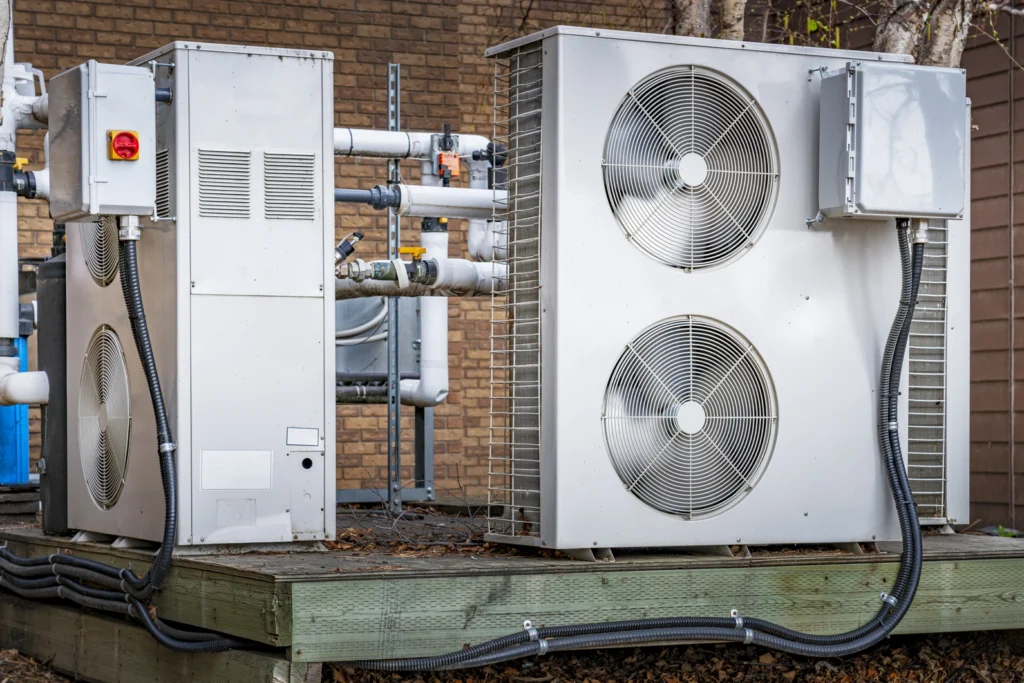
Commercial air-source heat pumps (ASHPs) operate on the same basic thermodynamic principle as domestic heat pumps — essentially a “refrigeration cycle in reverse” — but are scaled and configured to provide heating (and sometimes cooling) for larger buildings like offices, retail, or industrial premises.
1. Heat absorption (evaporation): A fan draws in outside air over an evaporator coil. Even cold external air contains some thermal energy. A refrigerant inside the coil — kept at low temperature and pressure — absorbs this heat and evaporates, turning from liquid to gas.
2. Compression: The gaseous refrigerant passes to a compressor, which pressurises it. Compression raises the refrigerant’s temperature significantly — “upgrading” the captured ambient heat to a usable, higher temperature.
3. Heat exchange (condensation): The hot, high-pressure gas flows through a condenser coil/heat exchanger inside the building (or connected to the building’s hot-water/heating system). There, the refrigerant releases its latent heat, condensing back into a liquid. The released heat warms water (or air) that circulates through radiators, underfloor heating, or air-handling units — providing space heating or hot water as needed.
4. Expansion: The cooled, liquid refrigerant then passes through an expansion valve. The valve reduces its pressure and temperature, returning it to the original low-temperature state — ready to absorb heat from outside air again.
Both air source heat pumps and ground source heat pumps extract heat energy from the environment, but the source differs:
Air source units pull warmth from the air and are easier and quicker to install—ideal for most commercial applications.
Ground source systems use underground pipes to collect thermal energy and are suited to sites with available land.
We’ll assess which system is suitable for your needs and guide you through the full solution, including funding advice where applicable.